Automated memory hygiene
How zero-memory detects duplicates, contradictions, and stale records — and resolves them without losing knowledge.
A memory store that only accumulates eventually works against you: stale and contradictory records pile up and confuse every future session. zero-memory ships an automated hygiene pipeline that keeps the corpus in shape. It finds duplicate, superseded, and contradictory memories across scopes, resolves the obvious cases automatically and reversibly, and brings everything genuinely ambiguous to a human.
Why write-time deduplication is not enough
Every remember call already deduplicates against near-identical records in
the same scope. That catches the most common case, but it is deliberately
narrow: it compares one incoming record against its closest neighbors at write
time. It cannot see a contradiction between two records written weeks apart,
a fact restated across scopes, or an older note that a newer record quietly
obsoletes. Proactive, many-to-many checking is a separate job, and that job is
the hygiene pipeline.
The two lanes
The pipeline is a two-lane design with a human in the loop:
- Sweep. A scan walks active memories and, for each one, finds its nearest semantic neighbors, across scopes, regardless of the language the fact was originally captured in.
- Judge. An LLM judge classifies each candidate pair as one of
duplicate,supersedes(in either direction, one side replaces the other),contradiction,complementary(related facets of the same topic that are both valid) orunrelated, with a confidence score. Acomplementaryverdict is what keeps two facts that merely look alike from being collapsed into one; see judge precision. - Auto lane. High-confidence duplicates and supersessions are resolved automatically: the losing record is superseded or forgotten. Every automatic action is written to the audit log and is reversible. Nothing is deleted, and any auto-resolution can be rolled back.
- Human lane. Low-confidence verdicts and genuine contradictions go to the memory review queue. The dashboard shows each pair side by side with the judge's verdict and rationale, and offers manual actions: keep both, supersede in either direction, forget either side, or merge.
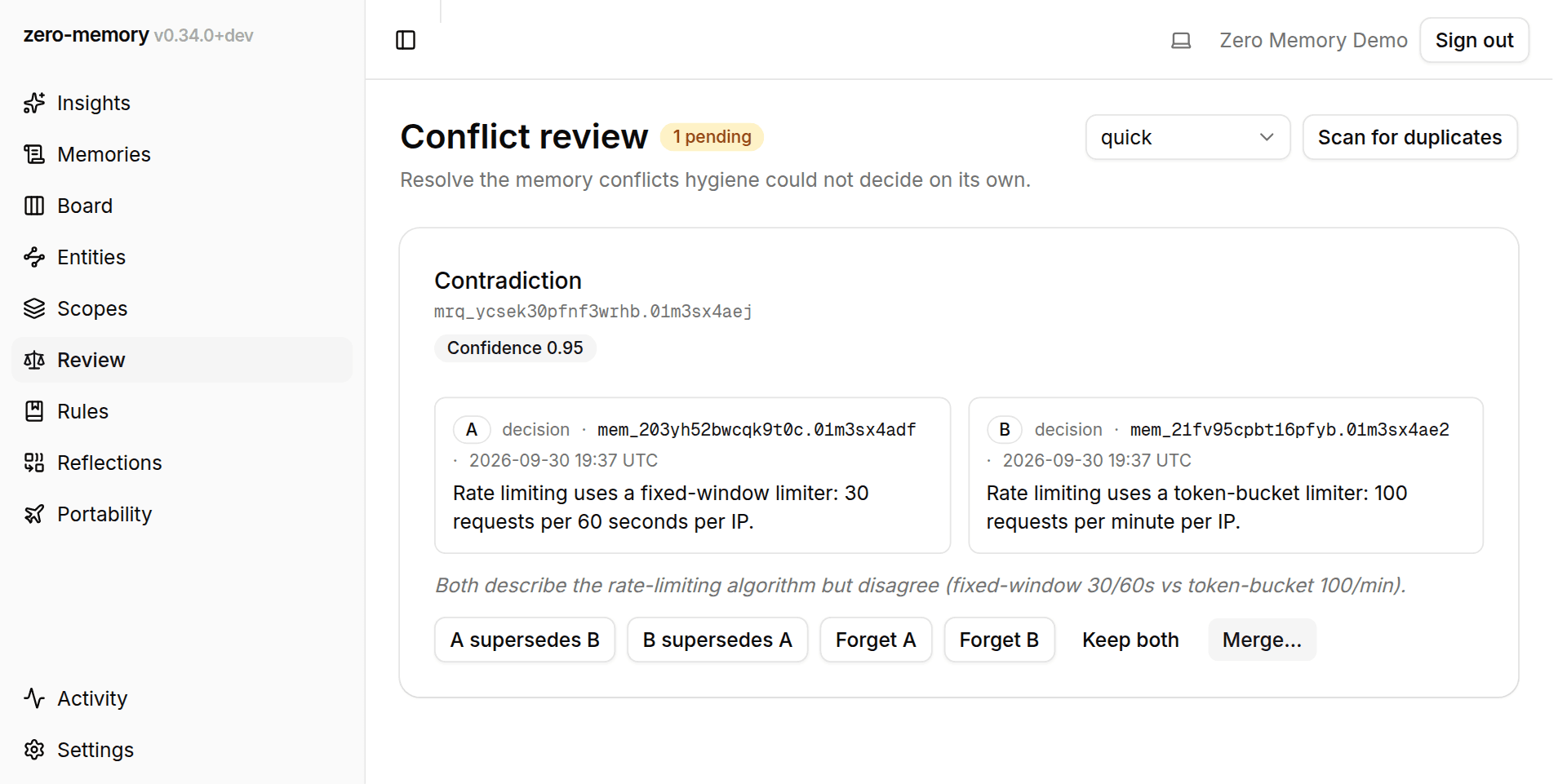
Besides pair conflicts, the same queue holds single-subject disputes: one
memory questioned on its own, with no counterpart. That can be an agent's
explicit challenge, a stale suspect flagged after repeated misled signals, or
a world fact an external re-check found outdated. The dashboard's review page
shows pair conflicts side by side; single-subject disputes are triaged
through the conflict tools (list_conflicts / resolve_conflict). See
the false-invalidation safeguards for
how they are raised and settled.
The pipeline reuses the same primitives as the rest of the system — similarity
search, supersede links and version history,
and the additive forget operation — so hygiene actions look exactly like the
actions an agent or owner would take by hand.
Triggers
Hygiene runs from three entry points:
- On write. When enabled (
ZM_HYGIENE_ON_WRITE), every new memory is scanned against its neighbors the moment it lands, so fresh conflicts surface within seconds, not on the next sweep. - On demand. The
scan_hygieneMCP tool, or the scan button on the dashboard's review page, starts a sweep over your own memories whenever you want one. - On a schedule. An opt-in in-process scheduler
(
ZM_HYGIENE_SCAN_INTERVAL_HOURS) runs system-wide sweeps at a fixed interval.
A system-wide sweep touches many people's memories, and each judgement is attributed to the owner of the memory under review: the judge call runs for that owner and lands on their usage ledger (and their own provider key, when one is configured). Corpus upkeep is work done for the corpus owner, not for the instance.
Sweeping the backlog
All three triggers above share one blind spot: they look at what was written recently. A store that has been accumulating for months carries pairs no sweep ever considered, because both sides were already old when the pipeline first ran, plus pairs a writer was shown at write time and simply did not act on.
The retro pass covers that backlog. It opens the same aperture the write path uses, one notch wider, and walks memories oldest-first instead of by recency. It is an operator command rather than a trigger, because a corpus is walked once and deliberately:
# from apps/server
bun run hygiene:retro -- --max 100
bun run hygiene:retro -- --max 100 --after 2026-07-01T00:00:00Z   # resume
Each batch reports the cursor to resume from, so the queue receives an amount someone can actually work through. Two properties make it safe to point at a long history. It never auto-resolves: every pair it finds parks in the review queue, so nothing is retired without a person. And it is idempotent, since a pair already in the queue is left exactly as it is.
--offer changes who judges. By default the pass asks the same server-side
judge as every other trigger. With --offer it runs no model at all: pairs are
generated deterministically from vector distance alone and parked with the
verdict unjudged, for the session agent reading the queue to adjudicate
through list_conflicts and resolve_conflict. Those rows carry no confidence
and no rationale, which is the honest state. Nobody has formed an opinion yet.
It is the same division of labour the write-time candidate hint already uses:
the server proposes, the reader decides. It also costs the instance nothing,
which is what makes walking a large backlog practical.
The write path and authority
Write-time deduplication cooperates with hygiene through an authority cascade
built on provenance ranks. When an incoming
record is nearly identical to an existing one in the same scope, remember
absorbs it silently only in two safe cases: the text is exactly identical, or
the incoming record is less authoritative than the one already stored. In
every other case the record is written and the write-triggered scan (or the
next sweep) judges the pair: different ranks resolve by authority, equal-rank
duplicates resolve automatically, and equal-rank contradictions go to the
review queue. This matters for the trickiest case. A short contradiction
phrased as a near-paraphrase ("X is blue" vs. "X is green") scores as
extremely similar while meaning the opposite. The cascade makes sure such a
counter-fact is surfaced as a conflict instead of being silently swallowed.
Portability audit
A fact about a public tool or technology written during project work lands in
that project's scope by the conservative write-time default, and stays
invisible to every other project's sessions, so the same lesson gets
rediscovered project after project. The hygiene cycle audits live private
project-scope memories of the world-facing kinds (fact, reference, and
gotcha), and when the judge confirms one is a portable world fact free of
project context, it files a reviewable proposal to move the memory into
your personal core scope. Nothing is ever re-scoped automatically: proposals
wait on the dashboard's portability queue with the judge's confidence and
rationale, and only your approval applies the move — reversibly, the original
scope stays on record. A dismissal is terminal: the same memory is never
proposed again. Conventions and preferences are deliberately never audited,
because whether they are "portable" is yours to say, not something a judge can
read off their content.
The same judgement also runs in the opposite direction, at write time.
While a project is in scope, a remember that asks for scope: "core" or
scope: "personal" is a request, not a command: a deterministic kind
prefilter admits only the world-facing kinds (fact, reference, gotcha
for core; preference additionally for personal, granted without a judge),
and the same portability judge must then confirm with high confidence that
the statement holds outside the project. The gate is fail-closed: no
configured model, a timeout, or a malformed verdict all deny. A denial is not
a refusal, though. The memory lands in the project and the response says so
(routed_to_project), with move_memories as the deliberate path if you
disagree. Audit and gate together make the portable layer a verified
place: nothing drifts in by assertion alone, in either direction.
Guardrails and deeper topics
Automation is only trustworthy if it cannot silently destroy knowledge. Four pages cover how the pipeline stays safe and scalable: the content guard keeps secrets out of the corpus before they reach storage or any external model; the false-invalidation safeguards guarantee that durable, authoritative knowledge is never auto-hidden and can always be restored; queue throughput explains how the review queue stays tractable without weakening those safeguards; and decay, reflection, and reinforcement describes how ranking evolves with age and usage so the corpus gets sharper the longer it lives.
Where automation stops
Observe, then act. The system was explicitly designed as "a surface where the obvious closes itself and the debatable goes to a human", not as a silent auto-deleter. The auto lane existed from day one only together with its audit log and rollback.
Judge false positives are contained, not merely hoped away: the confidence threshold for automatic action is conservative, and everything below it lands in the queue where a wrong verdict is visible.
Sweeps are incremental. Cross-scope comparison is more expensive than scoped write-time dedup, so scheduled sweeps focus on new and recently touched records rather than re-comparing the full corpus each run.