Supersede and versioning
How a writer that knows it is updating a fact declares the replacement explicitly, and how superseded memories form version history.
Facts evolve: a deploy window moves, a plan becomes an implementation, a
diagnosis is refined into a root cause. In zero-memory the writer that knows
it is updating a fact says so at write time. remember accepts a declared
supersede, which atomically stores the new memory and retires the old one:
no duplicate, no conflict queue, and a clean version chain behind every
current fact.
Why declare instead of detect
Without a declaration, an update lands as a second memory about the same topic, and resolution falls to the automatic hygiene pipeline: a small judge model compares the pair and, when its confidence clears the auto-resolve threshold, retires the older one. That safety net works, but for one common class it is backwards. Same-rank refinement is the case, where two authoritative memories describe one evolving topic. The judge's confidence on these pairs tends to land just below the auto-resolve bar, so they queue up for a human.
The absurdity: a strong writing agent that knows it is updating a fact defers the decision to a weaker probabilistic judge, which then misses the threshold. The writer has ground truth and intent; the declaration hands the decision to the party that has both. In practice most queued refinement pairs are written by the very agent that already knows about the replacement — see queue throughput.
What a declared supersede does
The declaration rides the existing links vocabulary, one syntax for one
intent. Arguments to the remember tool:
{
  "content": "Deploy window is Friday 14:00 UTC (moved from Monday).",
  "kind": "fact",
  "links": [{ "type": "supersedes", "dst": "mem_..." }]
}
On a write that declares supersedes links, the server, in one operation:
- stores the new memory as usual;
- retires each named target: sets its
superseded_byto the new memory's id and marks it invalidated, the same reversible lifecycle used byforget. Nothing is deleted; the store is forward-only and the retirement can be undone withrestore_memory; - records the
supersedeslink (new → old) so the version chain is explicit; - skips hygiene for this pair — the intent is declared, so no judge runs and no conflict is queued.
Guardrails cover the rest. Ownership and liveness are validated, with each
target handled best-effort: a dead, missing, or self-referencing target is
skipped with a log and the write still succeeds, while a target that is
invisible to you under row-level security (someone else's private memory)
rejects the link and fails the whole write. A write is capped at 10 declared
supersedes, because an update names its predecessors, it does not mass-retire.
Only authoritative writers may declare supersedes: the background watcher,
whose captures are provisional (see
Provenance), cannot, and the declaration is
reserved for in-band writers with ground truth. Superseding a
task or open-question also closes the loop (see
Open loops). And it composes with dedup: when an
incoming write is absorbed into an existing near-duplicate, the absorbing
memory becomes the successor for any declared targets.
Only a write retires anything. The link tool can record a supersedes
relation between two memories that already exist, but that link is a graph
edge and nothing more: the older memory stays live, and a loop it names stays
open. To replace a memory that is already stored, remember the newer one again
with the declaration; dedup absorbs the repeat, and the declaration still
applies.
Finding the predecessor, and reading the chain
The workflow leans on a habit agents should already have: recall before writing.
recallthe topic before storing — the stale version usually surfaces.- Recognize that the new statement replaces it, not complements it.
- Write the new memory with a
supersedeslink naming the old id.
The server also meets the writer halfway: a remember that did not
declare anything returns similar_existing, the live same-owner memories
nearest to what was just written, ranked by distance and capped at ten, each
with its age and a content preview, filtered so memories from a different
project never appear — plus a hint telling the agent what to do about them.
A writer that skipped the recall still sees, in the write's own response, the
predecessor it probably just rewrote, and can follow up with a declared
supersede immediately.
The list is bounded by rank rather than by a similarity window, and that is a deliberate correction. A window has two edges and both of them hid real predecessors: a precision floor high enough to stay quiet also discards roughly two fifths of the memories a write genuinely replaces, and an upper edge — added on the assumption that anything that similar is a duplicate the server collapses on its own — hid another quarter, because that automatic collapse only fires for a near-verbatim restatement written in the same session. The most similar memory in the store, written last month in another conversation, is exactly what a rewrite replaces, and it was the one thing the window could not show. Ranking has no second edge, and the cap keeps the reply a glance rather than a reading list. Candidates may come from your personal scope as well as the project you are writing into: the portable layer holds operating truth that project work routinely supersedes.
If no supersede is declared, because the writer did not recall or the fact is genuinely new, nothing degrades: the write goes through the normal dedup cascade and hygiene pipeline. Declaration is an optimization on top of the safety net, not a replacement for it.
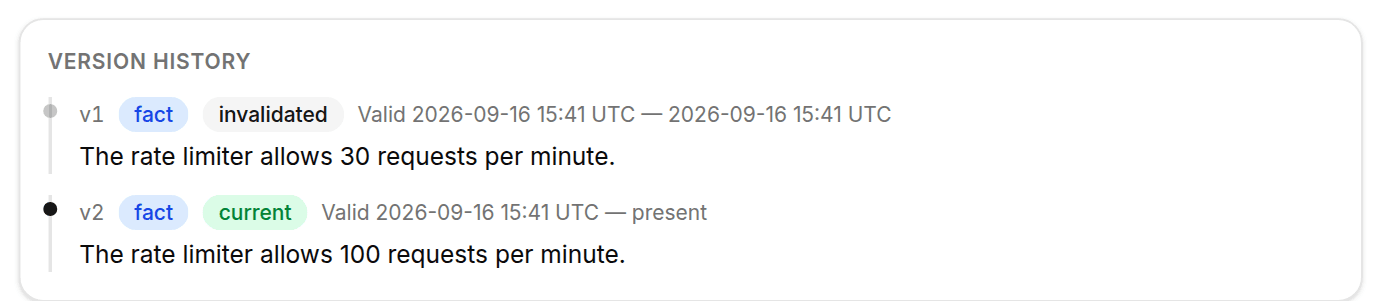
Superseded pairs do not appear in the conflict review queue, since an
intentional update is not a dispute. They appear as version history: the
chain of supersedes links behind a current fact, browsed rather than
adjudicated. The dashboard feed keeps that history out of the way. Its default
lifecycle filter hides superseded versions, and a memory's detail page shows
the full chain.
Why not a looser judge or three manual calls
Lowering the judge's auto-resolve bar for authoritative pairs was rejected. The judge often labels genuinely complementary facts as supersedes, and loosening the threshold risks silently losing distinguishable facts. An explicit declaration from the writer is safer than a bolder guess from the judge.
Manual recall → forget → remember was rejected as the answer. It is
already possible, but it is three calls, non-atomic, and leaves no
supersedes link, so the history disappears. The declaration makes the intent
first-class and atomic.
Reversibility is preserved by construction. Because retirement uses the
same add-only lifecycle as forget, a mistaken supersede is recoverable
and the superseded content remains readable in history.