Memory benchmark
A counterfactual benchmark that measures what you would lose without memory, run on your own data.
The memory benchmark answers the one question the other metrics cannot: what would you lose without memory? It generates a holdout of questions from your own stored knowledge, runs a real recall for each one, and has a judge decide two things per question. Could it be answered with what memory surfaced? Could a competent agent have answered it without your project memory, from general knowledge alone? The headline number is the exclusive rate: the share of questions answerable only with memory.
The counterfactual other metrics miss
Every other measure on the insights dashboard describes what memory did: recalls served, facts captured, briefings delivered. None of them establishes a counterfactual. Research on agent memory measures this by running the same tasks with and without memory; this benchmark is a built-in, inexpensive analogue that runs on your own data instead of a synthetic task suite.
From probes to the exclusive rate
Probes
Probes are generated from your live memories of kind decision, gotcha,
and convention: knowledge, not episodes (see the
memory model). For each selected memory, an
LLM writes one question to which that memory is the ground-truth answer. The
pool is topped up to a target of 20 active probes, and a probe is retired
when its source memory is invalidated, so the benchmark tracks your memory as
it evolves.
Because probe questions are derived from memory content, they are stored in server-only tables that no client can read directly; only aggregate results reach you, through an owner-scoped dashboard query.
Runs
A run is triggered with the benchmark_memory MCP tool:
- For each active probe, a real recall executes under your authenticated identity, with row-level security fully applied. This is a hard requirement, not an optimization: the search function honors the caller's permissions, and running it with elevated privileges would see memories you cannot, producing flattering, dishonest results. Each probe's recall is pinned to the read set of a session working where its ground truth lives, the source's project or team scope plus your personal layer. Without the pin, the score would be a property of the calling session: an unattached one reads all visible scopes and inflates the metric, while an attached one structurally misses every probe whose source lives in another project. Pinned per probe, the result measures the corpus, not where you happened to run the benchmark from.
- Judging then runs in the background. For each probe, a judge receives the
question, the ground-truth memory, and the surfaced results, and returns
with_memory,without_memory, and a confidence. Results are appended to a run record; nothing about your memories is modified. A probe whose judgment fails is skipped rather than failing the run, since a partial run is still a usable measurement. - Once judging finishes, the pool is topped back up from knowledge that has never been probed, newest first, so the next benchmark reaches what you have learned in the meantime instead of asking the same questions forever.
The call itself returns as soon as the recalls are done, reporting how many probes went into the run; the verdicts land on the dashboard shortly after. The first call may need to build the probe pool first; it then returns immediately with a "generating" status, so call again once generation finishes. Only one run executes at a time per owner, and a concurrent call reports that a run is already in progress rather than stacking a second one.
The metric
For each run:
with_memory— the surfaced facts answer the question;without_memory— a competent agent would have answered anyway;- exclusive —
with_memoryand notwithout_memory.
The exclusive rate is the fraction of probes that are exclusive: "this much of your working knowledge exists only in memory."
Deterministic mode
With ZM_EXTRACTOR=deterministic, the full cycle of generation, run and
results works without any LLM key. Probes fall back to templated questions,
and the judge becomes a strict retrieval check: with_memory is true only if
the ground-truth memory id is among the surfaced results, and
without_memory is always false. This is an honest lower bound on retrieval
success, and it
keeps the benchmark usable on a fully offline deployment.
Running it and reading the result
benchmark_memory is an MCP tool, not a shell command, so there is nothing
to type into a terminal. Ask the agent in any connected client to run it:
Run the
benchmark_memorytool.
The first call may return a "generating" status while it builds the probe pool; ask again once that finishes and the run itself starts. Only one run executes at a time per owner.
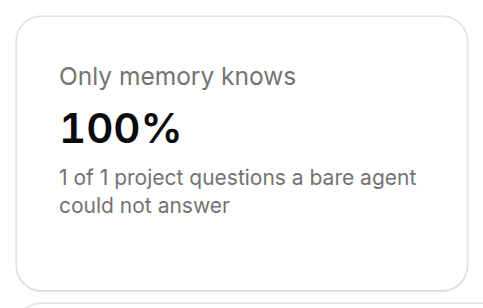
Then open the insights dashboard. The Only memory knows tile shows the latest run's exclusive rate with a hint like "7 of 20 project questions a bare agent could not answer". A trend sparkline appears once there is more than one run to compare. Before the first run, the tile shows an invitation to run the benchmark rather than a misleading 0%.
Runs are manually triggered; repeat the run after significant memory growth or a recall-quality change to see the trend move. Results are strictly per-owner: your probes and results are never visible to another user.
Cheaper stand-ins, and where results live
This is a periodic benchmark rather than live A/B cohorts. Splitting real sessions into with-memory and without-memory cohorts would double cost and deliberately degrade half of your actual work. A periodic holdout run measures the same thing without touching live sessions.
A judge stands in for full agent tasks. Replaying complete agent tasks with and without memory would be the gold standard but requires an agent runner and many model calls per probe. One judge call per probe captures most of the signal at a fraction of the cost.
Runs and results live in their own append-only tables rather than in usage events, because a benchmark result is not metered work, and keeping the domains separate keeps both schemas honest. The model calls the benchmark makes, however, are metered as usage events: both question generation and judging, tagged by purpose and attributed to the owner whose corpus was measured. Calls that ran on the owner's own provider key are marked and left out of the deployment's token totals, exactly as everywhere else — see Value metering.