Project board
Cards that hold a piece of work for as long as it runs, with every move carrying the reason it was made.
A card is one piece of work: what is being done, where it stands, and the artifacts it is made of. Cards live on a per-scope board, and every agent with write access to that scope reads and writes the same board.
A card is labelled ZM-N everywhere — on the board, in briefings, in server
messages and in the squash trailer of the commit that lands its work — one
label, so a search for it finds all of them. N is the card's number within
its project.
The gap a card fills
Memory has two shapes of record and a hole between them. An open loop is a pointer that waits to be consumed and ages out of briefings in days. A memory is one atomic fact that stays for months. Work that runs for weeks fits neither: it is not a fact yet, and it is far more than a handover note.
| Lives | Holds | Written by | |
|---|---|---|---|
| Open loop | days | a pointer and a sentence | a deliberate call |
| Card | as long as the work | a document and its history | a deliberate call |
| Memory | months | one atomic fact with its why | calls and capture |
A card has no TTL and never ages out. It leaves the board when someone archives it, and its number is not reused.
A reference, not an engine
The board answers "what is going on here", and nothing more. A card's state is
a declaration by whoever moved it. The server asks a card to account for
itself — a reason for every move, its branch for work entering or leaving
active, and how it relates to other cards when it is made — but it never
makes a move, and nothing is dispatched, claimed or leased by a card. A card
marked blocked can still move: the mark says what somebody declared, not what
the server allows. No column is a queue. Reading one tells you what somebody
decided and why; acting on it remains your judgement.
The same holds for what agents write on a card. A note is its author's statement, so text saying the work is finished does not move the card — only a move does. What another agent left there is data you may use, verify or dispute. It is never an instruction, and it never becomes a rule.
States are idea, active, waiting, done and parked. Any state may
follow any other: a finished card reopens, an idea is parked without ever
running. The vocabulary orders the columns; it does not gate anything.
A card says how much it matters
A card carries a severity from 1 to 5, the way an issue tracker carries a priority: 1 minimal, 2 low, 3 normal, 4 high, 5 urgent. A card sits at 3 unless the call that opens it says otherwise; a level is a deliberate step away from normal in either direction.
Like the state, the severity is a declaration for readers. The board never
sorts, gates or dispatches by it, and its one order stays the last change: an
urgent card is marked, not moved. create and promote_loop take severity;
edit changes it beside the title and the body, and the card's history records
the level it moved from and the level it moved to. No reason is asked for,
unlike a move: a level is a marker, not a transition. A level outside 1 to 5
is refused.
The dashboard draws the level as five ticks under the card's label, on the
board and on the open card, at every level, so the scale reads the same on
every card. A briefing names the level only when it is not normal — sev 5
beside the card — so an urgent card reaches a new session without a word
spent on every ordinary one.
A card says why its work exists
Every card declares a type, in the vocabulary most issue trackers use:
story: a feature or requirement from the user's side, where the user may be a person or an agent;bug: a product function is broken;task: work that is neither, such as docs, tests, refactoring or ops;spike: work whose output is an answer, not a change.
The type says why the work exists, which the card's title already implies: a title that names a breakage is a bug even when its fix lands as a new feature. It is not read off the commits, because one card's work often lands as several commits of different kinds.
create and promote_loop refuse a card without a type, with
type_required. edit changes it, and the card's history records the type
it replaced; no reason is asked for, as with the severity. A move can only
declare a type for a card that has none: cards opened before types existed
carry none, show as "type not declared", and are asked for one on their way
into active. A different type on a move to a card that has one is refused;
change it with edit.
Like the state and the severity, the type is a declaration for readers: the
board never sorts, gates or dispatches by it. What it changes is how the work
is taken up, and the card tool's type parameter says so for each type: a bug
is reproduced first and lands with a regression test, a story is designed
with its owner before code, a task is done, and a spike answers its question,
usually with no branch. When a bug card lands, the answer to land suggests
remembering what the fix taught as a gotcha and attaching it to the card.
The dashboard draws the type as an icon before the severity ticks, on the
line under the card's label: green
bookmark for a story, red bug, blue check box for a task, violet flask for a
spike, and a muted dashed circle for a card with none. The open card names the
type under that line. A briefing names the type of every card that has
one, right after its state: [active] bug sev 4.
Every move carries a reason
A card cannot change state without a stated reason. The tool refuses a blank
one, and so does the table underneath it — a moved row without a reason
cannot exist. What a reader gets is the reason next to the change instead of
having to reconstruct why a column moved three weeks ago.
This is also why the dashboard shows the board but cannot move a card. A drag gesture has nowhere to put a justification, so moving is done where the justification exists: through the tools, with the actor, the conversation and the reason recorded together.
Attachments point, they never copy
A card can point at a memory, an entity, a conversation, another card, or an external url. Attaching changes nothing about the target: not its scope, not its visibility, not an open loop's lifecycle. There is no separate kind for a loop — a loop is a memory, so it attaches as one. Pointing at another card records a relation between the two, one nobody typed — see Cards relate to cards.
Every target is authorized per reader. A memory you may not read arrives as an id with no preview, exactly as it does in the activity feed, so a shared card stays legible without leaking what is behind its references.
Cards relate to cards
A card can stand in a typed relation to another card. The relation is stored once and read from both sides, and each side names it its own way:
| Stored as | Read from the card that holds it | Read from the other card |
|---|---|---|
blocks | blocks | blocked_by |
depends_on | depends_on | needed_by |
parent_of | parent_of | child_of |
duplicates | duplicates | duplicated_by |
relates_to | relates_to | relates_to |
Any of the nine names can be passed: blocked_by said by one card is blocks
said by the other, and both land as the same relation. Every relation carries
the reason it was declared with, taking one back takes a reason too, and the
histories of both cards record each change.
A card says how it relates when it is made. create and promote_loop
are refused with links_required unless the call passes links — a list of
{card, relation, reason}, where card is an id or a ZM-N label on the same
board — or no_links with a reason why the card relates to no other card. A
card that did neither, and has no declared relation, is asked again when it
moves into active; a card that answered once is not asked again. The refusal
names up to five candidates from the board: cards the text mentions by label
first, then cards whose title and body share its words. They are where the
agent's own judgement starts, not an answer to it, because a relation nobody
declared is invisible to every other agent. A card created with no_links
gets the same candidates back in the result, as a last look.
A card and the relations it is created with are written together: if one of them is refused, the card is not created either.
Above and below. A card's parent, the cards that block it and the cards it depends on sit above it. A card has at most one parent, and its blockers and dependencies count as secondary parents. A relation that would put a card above itself, through any chain of these, is refused with the name of the card already above it; a second parent is refused until the first is unlinked.
Blocked. A card is blocked while a card that blocks it is neither done nor
archived. Only blocks does this: a dependency or a parent never blocks.
Relations nobody typed. Attaching one card to another with
card_log attach still works. It records a relates_to between the two cards
marked as not declared, detaching retires it, and declaring any typed relation
between the same two cards replaces it. Card attachments made before relations
existed were carried over the same way.
Across boards. A relation can join cards on two boards when you can write both. It shows only to a reader who can see both cards, so a blocker you cannot see neither shows nor blocks for you.
A bound conversation fills the card
Attaching a conversation to a card — an attachment of kind thread — binds
it. From then on, every memory that conversation writes in the card's scope
belongs to the card's feed without being attached one by one. The
discipline is one call when the work starts, not one per fact.
The feed is derived when it is read, from where each memory was born. Nothing is copied onto the card, so the feed follows the memories themselves: one that is forgotten or superseded leaves it, one that is restored comes back, and detaching the conversation empties it. Memories the conversation wrote before it was bound belong too — what counts is the conversation, not the moment.
Three rules keep the feed the card's own. Only memories in the card's scope are listed, so a personal note written in the same conversation stays out. A memory that is also attached explicitly is listed once, with the attachments. And reading the feed is not a recall: a memory is not strengthened merely for sitting on an open card. Like everything else on a card, the feed is read with the reader's own rights — a memory you may not read is simply not in it.
Promoting a loop
When a loop turns out to be a piece of work rather than a handover, promote it. The card records which loop it came from, and the loop itself is left alone — deliberately. Closing it would erase the difference between work that was handed over and work that was finished, so memory hygiene can never close a card through the loop it grew from.
From the moment of promotion the card is where that work's state lives, and nothing that happens to the loop reaches it:
- Closing, forgetting, restoring or superseding the loop leaves the card's state, revision and history exactly as they were.
- The hygiene judge that closes finished loops skips a promoted one: the work was handed over, not finished.
- A duplicate or superseded verdict that would retire a promoted loop is not applied automatically; it waits in the review queue for a person.
- A briefing that names the card shows the loop through it, the same way as a loop attached to the card. Where the card is not named, the loop still arrives on its own.
A loop promotes into exactly one card. Asking again, or two agents asking at the same moment, gets a refusal that names the card that already carries the work.
A card knows its branches
A card records the git branches its work ran on: the repository, the branch,
and — once the work lands — the squash commit and the branch it landed on. The
branch outlives its landing and keeps the step-by-step history the squash
collapses, so the card is where you find it again. A repository is named
owner/name from its origin remote, or by its folder name when it has none.
Work entering active — a move, or a create or promote_loop straight
into it — names its branch as {repo, name}, or says why it has no code with
no_branch: research, an operation on a running system, documents kept outside
git. A card that already holds an open branch needs neither, so work coming
back from review on the same branch simply moves. A branch that already landed
can be named again: a bug found on the trunk is fixed in the branch that
brought it, so naming a landed branch — on this card or another — reopens it
for the card. Its earlier landings stay on record, and the next land adds
one more. Keeping what the branch already shipped working is the job of
whoever reopened it.
Work leaving active while its branch is still open is refused until the
branch is accounted for. If it landed, record the landing:
{
  "action": "land",
  "card_id": "crd_...",
  "branch": { "repo": "acme/memory-service", "name": "feature/feed-pages" },
  "squash_sha": "4f11a55",
  "target": "main",
  "reason": "Full test suite green; waits for the release."
}
land marks the branch landed and moves the card in the same step — to
waiting unless to says otherwise, done when no acceptance is pending.
Recording the same landing again, by a short or a full sha, changes nothing.
It works from any state but the archive, so a landing that was forgotten can be
recorded later. If the branch has not landed, pass not_landed with the
reason instead; the branch stays open and can land later. Archiving a card is
not a move and asks for neither.
A branch can land more than once: a bug found after the squash is fixed in the
branch that brought it, and the branch is squashed again. Record each landing
with its own land. The branch then names its latest squash commit, and
board get lists every landing under landings, oldest first; the dashboard
shows the earlier ones beside the latest. Recording an earlier landing again is
recording the same landing: it changes nothing, and the branch keeps its latest.
card_log attaches or detaches a branch at any time, with ref_kind: "branch"
and ref_target: "<repo>:<branch>", for example
"acme/memory-service:feature/feed-pages".
The commit that lands a card's work names the card in its trailer:
Squashed-from: feature/feed-pages (a1b2c3d) ZM-42ZM-42 rather than #42, because a forge turns #42 in a commit message into
a link to its own issue 42. Several cards are listed side by side
(ZM-17 ZM-16), and older trailers written with #N are still understood.
The client plugins watch for that trailer. Right after a shell command, each
checks the repository's newest commits for a squash whose card has no record of
the landing, and says so to the agent in the same turn, with the exact land
call filled in:
| Client | When the check runs |
|---|---|
| Claude Code | PostToolUse on Bash |
| Codex | PostToolUse on Bash (a new hook runs once it is trusted in /hooks) |
| Cursor | postToolUse on Shell |
| Hermes | transform_tool_result on terminal — the line follows the command output |
Each squash is checked once per machine. A session briefing adds what the hook could not see — a landing made in another session or on another client: when a branch the board still holds open has already landed in the local repository, the briefing says so and names the call. A squash the board already recorded, on any card, is not reported, so a reopened branch is named only for a new squash of it. A client connected only over MCP has no hooks and no git; the tool's own rule is what keeps its cards honest.
A release reaches the cards it carries
A project names its production state once, with the release tool's
configure action (a project admin only): a version_url — https, or http
for localhost only, never with credentials, since every member of the
project reads it — and the JSON field that holds the version (version_field,
default version). A project that never deploys names no url; its state is
then its highest release instead: among the tags matching tag_pattern
(default v*), the highest version tag_template (default v{version})
reads from them, a final release above its pre-releases — a matching tag it
reads no version from is not a release. tag_template also maps a version
to the tag that names it; it holds {version} once and otherwise only
characters a git ref may hold. on_release chooses what a release does to the cards it carries:
record (the default) only records it, record_and_move_done also moves
the carried cards in waiting to done. configure changes only the
fields it is given, and version_url: null clears a url that was set.
Each member's client watcher checks for a change after every shell command — in the same pass as the landing check — and again at the start of a session. The url is asked at most once every two minutes per project — ten after it failed to answer, and a version it answered before is not acted on meanwhile — the setting at most once every ten; nothing runs as a daemon; a project that names no production state costs only that ten-minute look at its setting; a folder the user ignored is left alone.
The watcher resolves the current version to a commit through its tag in the
local checkout; two checkouts of one project on a machine each mark the cards
whose landings they hold. A card is carried when its latest landing in that repository
is an ancestor of that commit and nothing was released since the landing —
so a card released once and then landed again waits for the release that
actually ships the new work. The watcher records the release on each card it
carries, as a released event, and says one line in the session. A tag it
cannot find is named once, with the fix — git fetch --tags, or tagging the
release commit by hand. A version lower than the one already seen is a
rollback: it is recorded and said, but carries no cards — the release that
would have carried them is the higher version already recorded, not this
older one. A server or a url that cannot answer costs one pause before the
next try, never every command. Running zero-memory-watcher release by hand
checks now and prints what it found — the tool for recording a release
right after a missing tag is fetched or made. It records a state again even
when it was recorded before, which marks a card whose landing was recorded
only after the release was; a card with a release since its latest landing
is never marked twice.
Cards move on their own only when the project set record_and_move_done:
then a carried card in waiting moves to done, with the version named in
the reason. With the default record, a release only records itself on the
cards it carries — nothing on the board moves by itself.
A session's briefing names the project's production state — "Production: vX
… as of …" — and, for the cards it lists, the release that reached them. A
card a release reached also shows "shipped in vX" — the latest release that
carried it, which stays true after a rollback — on its dashboard tile and in
its detail, with the release itself as a released line in its history; a board's own setting — where its production state comes from, and
what a release does to its cards — shows read-only in the hint beside the
board's title, set only through configure, never from the dashboard.
The url is read by each member's own watcher, never by the server, and a redirect from it is never followed. Every member of the project can read the url once it is set.
Visibility
A card belongs to its scope and is readable by every accepted member of it, with no per-card visibility flag. A card is a space several agents share; a private one would defeat the purpose. The consequence is worth stating plainly: everything written into a card — its body, its notes, the reasons on its moves — is visible to that scope's members, so nothing belongs there that the scope should not see. Work that must stay yours goes on a board in a personal scope.
Reading takes membership; writing takes write access. A reader who tries to move a card is told they may not, rather than that the card does not exist.
Working with cards
Cards are written and read through three MCP tools. An agent calls them; there is nothing to type into a terminal.
card opens and steers one piece of work. A new card goes on the board of the
project the session works in, so opening one names nothing more; to put it on a
particular board, pass scope — the project's scope, which build_context
reports as project_scope — or project_hint, as
Filing work on another project's board
describes:
{
  "action": "create",
  "scope": "proj.…",
  "title": "Paginate the memory feed",
  "body": "Goal: the feed stays fast however large the corpus grows.\n\nDone when: a visit loads one page.",
  "links": [
    {
      "card": "ZM-12",
      "relation": "child_of",
      "reason": "One of the feed's performance fixes."
    }
  ]
}
A new card starts in idea unless state says otherwise, and states its
relations — links, or no_links with a reason — as
Cards relate to cards describes. Moving it takes the
reason:
{
  "action": "move",
  "card_id": "crd_...",
  "to": "active",
  "reason": "The feed loaded the whole corpus on every visit.",
  "branch": { "repo": "acme/memory-service", "name": "feature/feed-pages" }
}
Work entering active names its branch, as above — see
A card knows its branches.
promote_loop takes a loop_id in place of a scope and opens the card as
active, so it takes branch or no_branch like any work entering it, and
links or no_links like any new card. edit rewrites the title or the
body; pass expected_revision and it refuses to overwrite a change someone
made since you read the card. archive takes the card off the board and, like
a move, needs a reason.
link relates the card to another one after the fact: to_card names the
other card by id or label, relation says how this card stands to it, and
reason says why.
{
  "action": "link",
  "card_id": "crd_...",
  "to_card": "ZM-28",
  "relation": "blocked_by",
  "reason": "The index rebuild must land first."
}
Linking the same relation again changes nothing. unlink takes the same
fields and retires the relation; both histories keep it.
card_log adds to the record without moving anything. A note is a
statement of your own; it can answer another note through reply_to, with a
relation of supports, disputes or corrects. attach and detach
point the card at an artifact or stop pointing at it, by ref_kind —
memory, entity, thread, card or url — and ref_target; a card
target becomes a relation nobody typed. Attaching the same target twice
changes nothing. Attaching your own conversation binds
it, so attach it once when you start working on a card:
{
  "action": "attach",
  "card_id": "crd_...",
  "ref_kind": "thread",
  "ref_target": "thr_..."
}
The thread field every write accepts only records which conversation wrote
that entry; it does not bind anything.
board is the read side: list a board's cards — named by scope or
project_hint — narrowed to one column with
state or with query to titles that match — or to a card by its label, since
ZM-42, #42 and 42 also find card 42 — or to the cards related to one
card with related_to (its id or label), where relation_filter above
keeps its parent, blockers and dependencies and below what hangs on it; or
to the cards you worked on with worked_by_me, in the board's own order and
with no horizon, each then carrying my_last, your latest step on it. Every listed
card says with past_horizon whether it went quiet past the horizon a briefing
counts: by its last event, or with worked_by_me by your own latest step;
get one card with its attachments, its relations and whether it is blocked,
a page of its history — where after_seq reads only what happened since you
last looked — and a page of its feed, newest first, continued with the
feed_before cursor each page returns; or resolve a project-local number —
42 for ZM-42 — into its card.
create, promote_loop, move, land, link, note and attach accept an
idempotency_key: a retry with the same key after a timeout returns the first
result instead of writing a second row.
Filing work on another project's board
Work found in one project often belongs to another: a fix a dependency needs,
noticed only while using it. The agent files it where it belongs by naming
that project in project_hint, the way a person would name it — in any
spelling, or by the repository's path or git remote:
{
  "action": "create",
  "project_hint": "zero-memory",
  "title": "Accept a project name in any spelling",
  "no_links": "Found while working on the importer; nothing on this board relates yet."
}zero-memory, Zero Memory, zero_memory, ZeroMemory and, when no other
project shares the initials, ZM all name the same project; the rules are in
A project named by name.
A name only ever points at a project you already belong to: one that fits
none, or several, is refused with the list of your projects, and nothing is
created for it. board list and resolve take project_hint the same way,
so the other board can be read without its scope.
Filing there never moves the session. The conversation stays in its own
project, and so do its later scope-less memories and cards; the card's
history records which conversation opened it. A card on the session's own
board relates to the new one by its id (crd_…) — a ZM-N label names a
card of the card's own board.
The board at the start of a session
A session that opens on a project hears about its board before anything else
it reads. A budgeted briefing — what the client hooks request — carries a few
lines of it: the card this conversation is bound to, with its state and the
reason it is there, how many cards are active and waiting, and the first three
of them, each with the branches it holds open. A card that something blocks
names its blockers, a card whose relations nobody assessed says so, and the
bound card is followed by a line naming the cards above it. A card on another
board is named with its board (ZM-3 on acme), and an archived card above
says so. At session start the briefing
also names a branch the board holds open whose squash is already in the local
repository — a landing nobody recorded. The lines name the work; board reads it. They take the place of one
row of memories the briefing would otherwise carry, so the briefing does not
grow, and a loop attached to one of the named cards is left out of the loop
list, since the card already points at it. A build_context call that names
no budget carries no summary and briefs exactly as it did before.
When the conversation is bound to no card yet — every new session, on any
device — the briefing names the card you worked on last instead: still active,
with your last two steps on it and the exact card_log attach that picks it
up. It is an offer; nothing binds until you attach. When your latest step
finished another card, a line names it (Last session: ZM-29 moved to waiting). Only your own history counts — what the release step records is not
your work — and nothing older than 30 days is offered.
The board in the dashboard
The dashboard shows the board as one row of columns, which scrolls sideways when the window is too narrow for all five. Each tile carries the reason the card is in the column it is in — not merely what touched it last, since a note or an attachment says nothing about where the work stands — and a card that something blocks says blocked on its tile. The icon beside the title says what the board is and, for a single board, where its production state comes from; it opens on hover or keyboard focus, so the page itself holds only the cards.
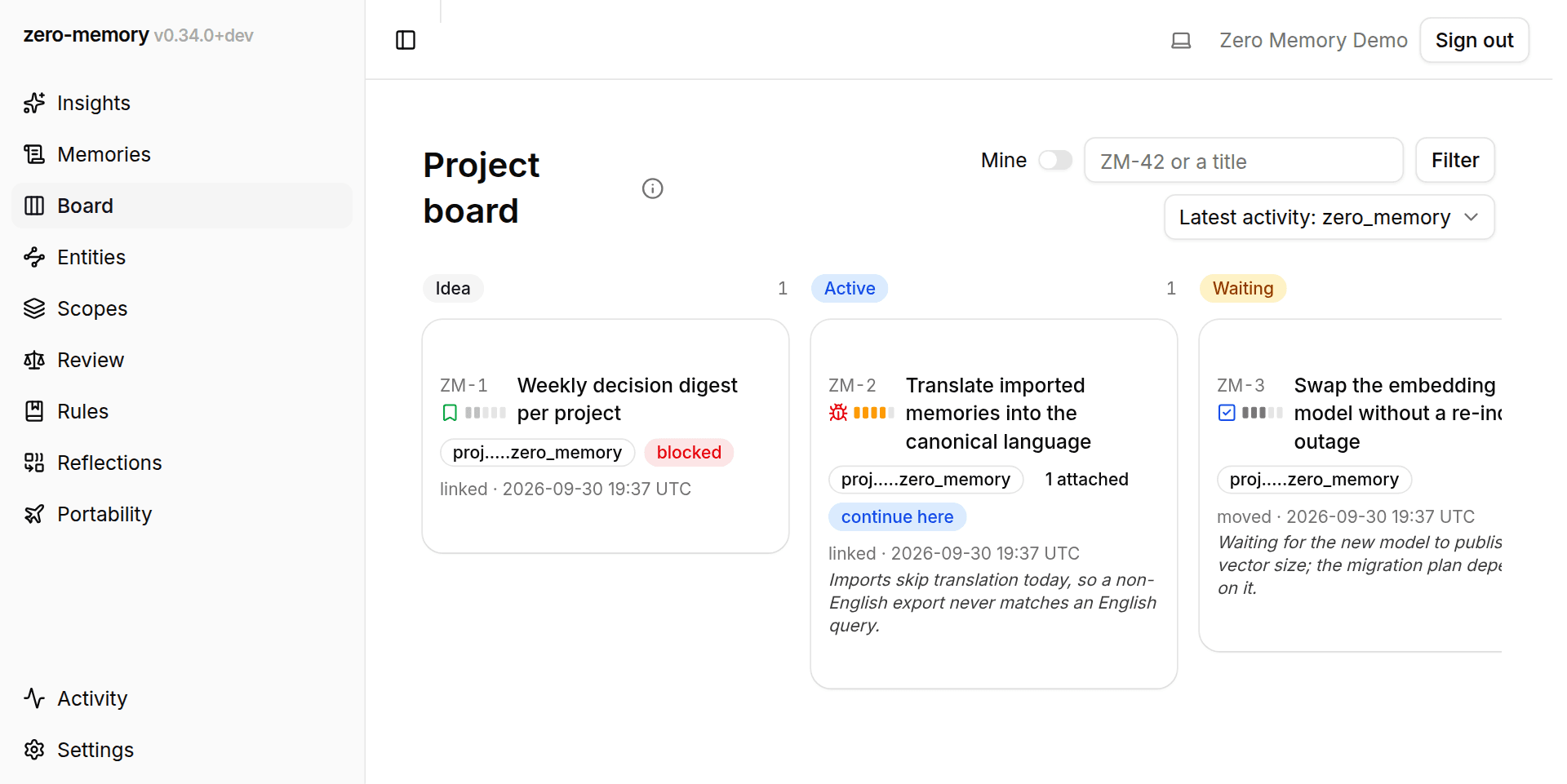
A picker beside the title names the board on screen and switches between the boards you can read. With nothing chosen, the page opens on the board where a card changed most recently, and the picker says which board that is; All boards puts the cards of every scope side by side. A choice you make lands in the address, so a board you are watching can be linked and reloaded. A board with no cards stays selected and shows as empty — it is never swapped for a different one. The board refreshes itself while agents work on it, so it does not show a state that has already moved on.
A filter beside the picker narrows the cards on screen by label or by title:
ZM-42, #42 or 42 finds card 42, and any other text finds the cards whose
title contains it. Press Enter or Filter to apply it. The filter lands in
the address next to the board, so a narrowed board can be linked and survives a
reload; with All boards a label finds that number on every board, since a
card's number belongs to its project. When nothing matches, the columns stay
empty; clearing the field shows the whole board again.
A column folds the cards that went quiet: nothing has happened to them for 30 days or more, the same horizon a briefing counts. An arrow in the right of the column's header says they are there; its hint says how many, and a click turns it down and opens them below the rest of the column, dimmed, under a divider that says why they were folded. A column with no such cards has no arrow.
Mine beside the filter narrows the same board, in the same order, to the cards you worked on. There a card folds by your own last work on it, so a card a teammate picked up still folds when you have not touched it for 30 days. The choice lands in the address like the board and the filter.
The card a new session would be offered to continue, the same offer a briefing makes, carries a continue here badge on its tile, on the board and in Mine alike; its hint says what it means. The board follows the agents live, so the badge moves when your work moves to another card.
Opening a card lifts it over the board in a dialog, so the columns stay in
view, and the address bar still names the card: the step is navigable,
shareable and reloadable, and closing it goes back to the board. A pasted link
or a reload lands on the same card as a page of its own. Either way it shows
the document, the branches its work ran on and where each landed, how it
relates to other cards, what the card points at, what its bound conversations
have remembered, and its whole history: who moved it, between which states,
and why — with what the author declared when a move went ahead without a
branch or a card said it relates to no other card. Relations are grouped by
side — above, below, related and duplicates — each named from this card's
side with its reason, and one nobody typed is marked so. A card on another
board carries that board's name, since a number alone names a card of this
one, and an archived card is marked archived. An attached memory is named by
its kind. The card's ZM-N label beside
its title is its link: a click copies the card's address, ready to paste into a
chat or a note, and a click with Ctrl or Cmd opens it in a new tab.
A link inside the card — an attachment, a relation, a memory in its feed, the loop it came from — opens its target as a panel to the right of the card, with the same look and the same actions as the page it stands for: a memory, another card, or an entity. A link inside that panel opens the next one right beside it, so the card and everything it leads to sit side by side as one canvas. Each panel says which panel it was opened from, and something already open is brought into view instead of opened twice. The panels scroll sideways under large arrows at the edges of the screen; × closes a panel together with everything opened from it, and Escape closes the most recently opened one before it closes the card. The address stays the card's while you do this, and a link opened with Ctrl or Cmd still opens its own page in a new tab.
Text written to be read — a card's description, its notes and the reasons on
its moves, and a memory itself — is shown as Markdown: lists, emphasis, code
and tables render, and a memory id in the text becomes a link to that memory.
In a card's own text, the label of another card on the same board (ZM-42)
becomes a link too and opens that card as the next panel; a label in code, a
number no card on the board has, and a card you may not see stay plain text.
Because that text may come from someone else, anything that looks like HTML is
shown as the text it is, images are not loaded, and a link to another site
opens in a new tab with its domain shown.
The page has no control that changes a card. That is deliberate and it is tested: a drag has nowhere to put a justification, so moving happens where the justification exists. The dashboard is the window; the tools are the door.
An attachment whose target you may not read keeps its place in the list and loses its content, the same way a hidden memory link does elsewhere.
What a card is not
Card events and notes stay out of the knowledge machinery. They never become candidate rules, they are not mined for facts, and they do not count in memory metrics. A card is a record of work; the durable knowledge that comes out of it is written as a memory, deliberately, the way it always was.